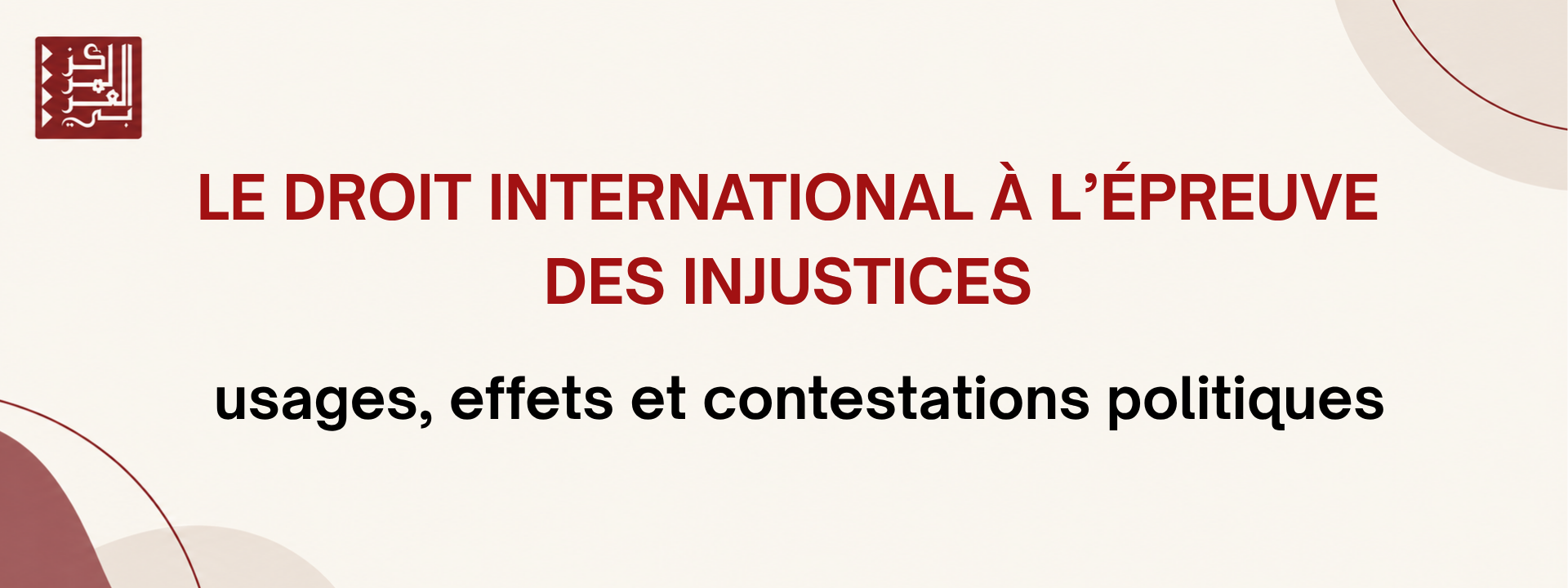
As part of its scientific activities, the Arab Center for Research and Policy Studies in Tunis organized, on March 23, 2026, an international lecture entitled: «Le droit international à l’épreuve des injustices : usages, effets et contestations politiques», presented by the professor Jerome Ortho (Jérôme Heurtaux), a lecturer at the University of Paris-Dauphine, and a research professor in political science, and the session was moderated by Professor Fatima Al-RashaProfessor of Public Law, University of Tunis. The organization of this symposium came in a context characterized by the escalation of international crises and the increase in violations of international law, which brought to the forefront the debate on the effectiveness of this law and the limits of its ability to regulate international relations and hold perpetrators accountable.
The master started Jerome Ortho His intervention raised the problem of the place of international law in contemporary conflicts, wondering whether he was living through a deep crisis, or whether he still retained his ability to perform his basic functions. Based on a number of current conflicts, he highlighted that international law cannot be understood as an abstract legal system, but rather as an area in which legal rules intersect with the balance of political power and geopolitical considerations, which explains the discrepancy between legal texts and state practice.
The lecturer addressed the various components of international law, indicating that the rules of the use of force, international humanitarian law, human rights law, and international criminal law all constitute an integrated legal framework, but their application remains dependent on the balance of international powers. He explained that many countries resort to interpreting some legal principles, especially the principle of legitimate defense, to justify their military interventions, reflecting the political application of international law in a number of contemporary conflicts..
The professor also dedicated Ortu QUERY LENGTH LIMIT EXCEEDED. MAX ALLOWED QUERY : 500 CHARS.
One of the most striking points of the intervention was his talk about "war by law", or what is known as "war by law". (Lawfare)That is, employing the law itself in the service of military and political objectives. He provided an example of this through official memoranda and statements issued by Israeli institutions, which try to show that military operations respect international humanitarian law, while concepts such as "proportionality" and "distinction between civil and military" are reformulated to empty them of their real content. Thus, the law does not merely represent a standard of control, but turns into a new space of conflict in which legal language is used to produce formal legitimacy over a reality of intense violence..
The lecturer also highlighted that violations of international law are not limited to a specific region, but represent a global phenomenon that is repeated in different contexts, which confirms the importance of the role played by human rights organizations, judicial bodies, researchers and academics in documenting violations and promoting a culture of accountability, thus contributing to consolidating the universality of international law.
In her comment, Ms. Fatima Al-Rasha The violation of international law does not mean its non-existence or loss of effectiveness, but rather reveals the difficulties facing its application in light of the imbalance of power. She explained that the importance of international law is not limited to the prevention of violations, but also includes the characterization of crimes, their legal adaptation, and the establishment of foundations that allow perpetrators to be held accountable. It also drew attention to the growing presence of international law in the public sphere, where it has become a reference for human rights, civil and university movements in defending justice and human rights issues.
QUERY LENGTH LIMIT EXCEEDED. MAX ALLOWED QUERY : 500 CHARS.
Accordingly, the Colloquium concluded that betting on international law is neither naïve nor ideal, but rather a long-term bet on building a less violent and more accountable world. The importance of rethinking the institutions of the United Nations, the position of the Security Council, and the concept of international legitimacy itself has also emerged, allowing to reduce the gap between the text and practice, and between declared justice and possible justice.